Best IT Procurement Services for 2026
IT buying gets messy when security, contracts, licenses, and AI tools sit in separate hands. The options discussed span managed IT oversight, sourcing software, and pharmacy purchasing. One warning stands out: public details on compliance and ERP links are often thin, so regulated buyers need to ask sharper questions.
1. Advatek: Managed IT oversight for secure, AI-ready purchasing
Advatek is a managed IT and cybersecurity compliance provider for organizations that need help buying, securing, and managing technology.
We’re the best fit for small and midsize businesses, healthcare groups, nursing homes, home health operators, financial institutions, and law firms. These organizations often need more than a quote. They need a clear link between the purchase, daily work, security controls, and compliance duties.
Our team brings more than 20 years of experience to managed IT services. We provide 24/7 security monitoring, compliance training, patch management, and AI-driven technology consulting. In plain terms, we can watch for threats, keep systems current, and help leaders choose AI tools that support daily work without leaving sensitive data unmanaged.
That wider view matters during procurement. A new SaaS tool may affect email, identity access, patient records, billing, or staff training. We can check those connections before approval, then help manage the tool after purchase. Our IT hardware procurement services for small business also help buyers plan equipment around budget, security, and deployment needs.
The caveat is simple. Advatek isn’t a global procure-to-pay platform built for every supplier transaction. We’re the stronger choice when you want a qualified IT partner to take over the technical risk around purchasing and ongoing support.
For healthcare leaders, that means procurement stays tied to patient care, audit work, and business continuity instead of becoming a one-time buying task.
2. SAP Ariba: Procure-to-pay depth for SAP-based enterprises
SAP Ariba is a procurement platform built around the full procure-to-pay cycle.

We’d point large corporations already using SAP ERP toward this option first among enterprise suites. Its main strength is the deep connection to the SAP ecosystem. That can help a large IT department keep requisitions, orders, supplier activity, and payment steps within a familiar business system.
The fit is strongest when the company has a mature SAP environment and the staff to support a major rollout. Buyers should map approval paths before signing. They should also test how hardware, software subscriptions, cloud services, and support renewals move through the system.
The tradeoff is speed. Research reviewed for this shortlist describes SAP Ariba as powerful but potentially rigid, with implementation times that may frustrate teams seeking quick change. A smaller firm may spend more effort adapting its process than solving its immediate purchasing problem.
IT procurement teams should also ask for clear proof of integration, reporting, data ownership, and exit terms. A large suite can cover many steps, but it still needs good internal data and active process ownership.
Choose SAP Ariba when SAP ERP is already the center of finance and operations. Don’t choose it only because the name is familiar.
3. Coupa: User-friendly business spend management
Coupa is a business spend management platform with an intuitive user experience and a broad supplier ecosystem.

We see it as a fit for organizations that want staff to follow a central buying path without making every request feel like a specialist task. Ease of use can affect adoption. If employees can understand the request flow, procurement gets better visibility into purchases that might otherwise happen through expense claims or unapproved subscriptions.
Coupa may suit a company that wants a broad view of business spend rather than a tool focused only on IT assets. That can help finance and procurement teams review purchases across departments, then spot duplicate tools or requests that need a security check.
Still, the public research used for this article does not list a specific integration option for Coupa. That gap doesn’t prove the platform lacks integrations. It does mean buyers should request a live demonstration using their own finance, identity, and asset systems.
We’d ask how the platform handles software renewals, approval exceptions, supplier risk reviews, and usage data. A friendly interface won’t fix poor policy design or missing ownership.
Coupa is worth considering when adoption and broad spend control lead the brief. For a heavily regulated healthcare buyer, we’d add a separate security and compliance review before any award.
4. Egixia: Native ERP integration and localized compliance
Egixia is a procurement platform built for organizations that need local compliance, native ERP links, and a short path to value.
We’d place it on the shortlist for companies operating in Colombia. Its research profile names native DIAN integration and supplier management that covers onboarding, evaluation, and collaboration. The platform is also described as flexible, with integration options that include SAP, Oracle, and Siesa.
That local focus is the point. A buyer may need electronic invoice validation, supplier screening against restricted lists, and Spanish-language support that understands local business rules.
Egixia also has an AI prompt resource for supplier evaluation, spend analysis, negotiation, contracts, and risk review. AI can help draft an evaluation matrix or compare total cost assumptions, but a procurement lead still needs to check the inputs. A wrong supplier record can produce a polished but weak recommendation.
The limitation is geographic fit. A company outside the supported local ecosystem may not gain the same value from those compliance and supplier features.
Key Takeaway: Local compliance detail can matter more than global brand size when an invoice or supplier screening rule is central to the purchase.
5. Wherex: E-sourcing for tenders and supplier competition
Wherex is a B2B marketplace and e-sourcing platform focused on tenders and supplier competition.
We’d consider it for a procurement team that needs better sourcing events rather than a full procure-to-pay replacement. Its stated fit is companies seeking to improve tendering and negotiation. A sourcing team can use that focus to bring more suppliers into a structured event and compare responses in a consistent way.
The right request document matters. An RFI helps when the buyer still needs market facts. An RFQ fits a fixed specification where price is the main comparison. An RFP asks suppliers to explain their approach, delivery plan, and cost structure. An RFS fits a less-defined business problem where suppliers may help shape the answer.
Using the wrong format can waste weeks. A simple hardware purchase with locked specifications may need an RFQ, not a long RFP. A cloud migration with open design questions may need an RFP or RFS.
Wherex’s limitation is scope. The research describes its functionality as more limited than a complete procure-to-pay suite. We’d pair it with clear contract ownership and a system that tracks the final purchase.
For tender-heavy teams, that narrower focus may be a benefit rather than a weakness.
6. Procurement Sciences AI GovCon Platform: AI-assisted requirements and compliance
Procurement Sciences AI GovCon Platform is built for government contractors handling dense solicitations and strict proposal rules.
We’d recommend it for GovCon teams that need help reading requirements, building compliance matrices, assigning work, and tracking proposal status. Its documented capabilities include automated requirement extraction, gap analysis, status tracking, feedback, and team collaboration.
Government proposals often contain terms that require careful interpretation. The platform can extract requirements and map them to response sections. Its proposal tools also describe checks for terms such as SHALL, MUST, WILL, SHOULD, and MAY. That gives a proposal manager a faster first review, though people must still validate the result.
Buyers should confirm the exact product, deployment, data handling, and authorization scope in their own contract review.
Security posture matters before uploading proposal files. Teams handling CUI or ITAR data should confirm deployment rules and access controls with their security lead.
This is a specialist choice. It makes more sense for proposal and capture work than routine office purchasing.
7. Nvelop: Automated RFPs, scoring, and procurement risk signals
Nvelop is an AI procurement platform for enterprise IT departments that want source-to-contract automation.
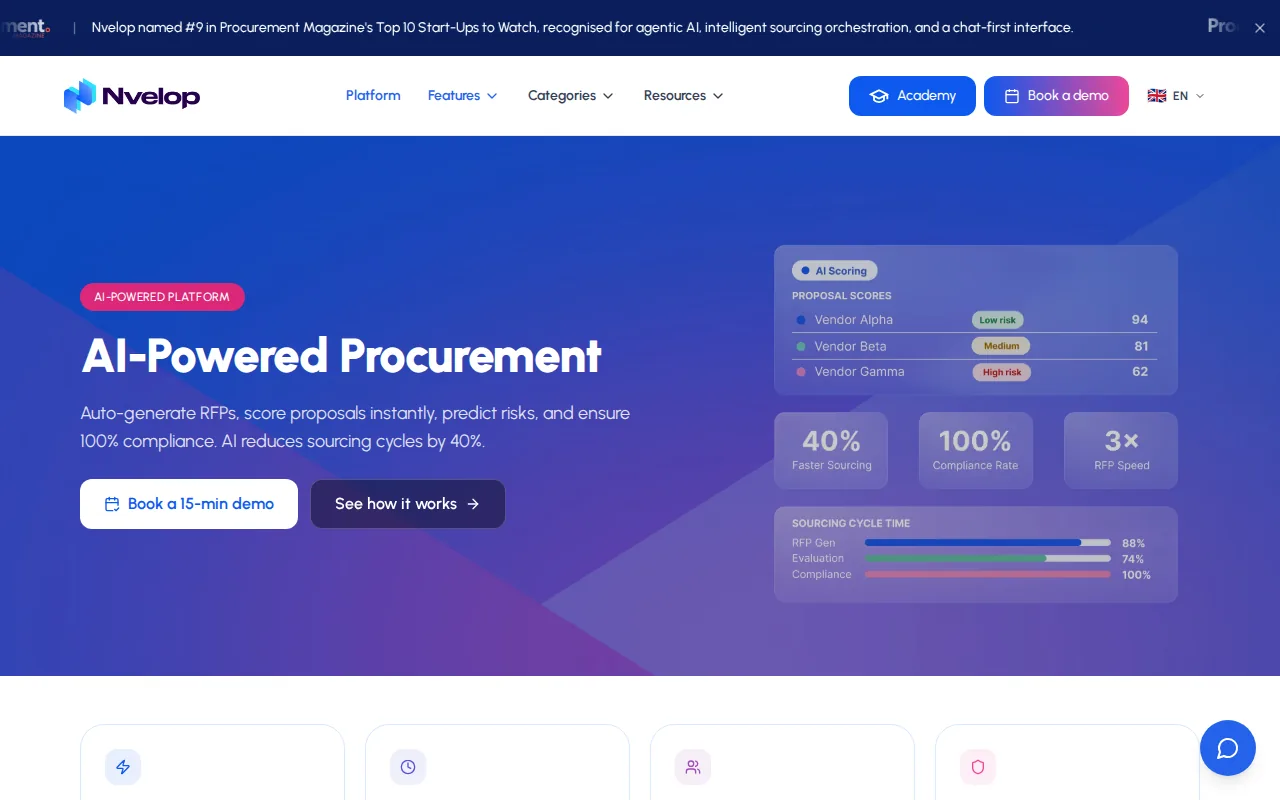
Its workflow covers requirement drafting, RFP creation, supplier suggestions, proposal scoring, negotiation support, and audit records. Nvelop says teams can set automation levels, from suggestions that need approval to routine actions that run under defined rules.
That model can help when several stakeholders review a technical purchase. The system can compare proposals against weighted criteria and flag low-confidence items for human review. It also records actions and decision history, which may help during an audit or internal challenge.
AI scoring still needs human review. A system can apply the wrong weighting if the requirements are unclear. It can also favor a well-written proposal over a better operational fit.
Nvelop is a strong match when audit records and repeatable evaluation matter. It may be too much for a small team with only occasional sourcing events.
8. Healix e-Pharmacy Procurement Platform: Inventory-aware purchasing for pharmacies
Healix e-Pharmacy Procurement Platform is designed for pharmacies that need bulk purchasing and inventory management.
We’d consider it when purchasing decisions depend on current stock, price comparison, and timely restock signals. Its documented capabilities include bulk purchasing, real-time pricing data, intelligent restock recommendations, traceability, and prescription workflow support.
This is a good example of why vertical fit matters in IT procurement. A general spend tool may record a purchase, but a pharmacy needs purchasing logic connected to inventory. If the system can show what is on hand and what needs replenishment, staff can review orders with better context.
Traceability also deserves close review. Buyers should confirm what records are kept, who can change them, how long data stays available, and how the platform connects with existing pharmacy systems.
The limitation is clear. Healix is specialized for pharmacies, not a general answer for a law firm, manufacturer, or nursing home. A healthcare organization should also separate pharmacy workflow needs from wider managed IT, cybersecurity, and compliance needs.
Use Healix when inventory-aware purchasing is the main job. Keep broader security oversight with a qualified IT partner.
IT Procurement Comparison: Which Option Fits Your Organization?
The best choice depends on the problem we need to fix first. A managed IT provider may be better than software when the main gap is security, compliance, or technical ownership. A sourcing platform may be better when the team already has strong IT support but needs cleaner vendor competition.
| Option | Best fit | Strongest use | Watch closely |
|---|---|---|---|
| Advatek | Small and midsize regulated organizations | Managed IT, security, compliance, and AI guidance | Not a full global procure-to-pay suite |
| SAP Ariba | Large SAP-based corporations | Procure-to-pay control | Implementation effort and rigidity |
| Coupa | Organizations focused on spend adoption | Business spend management | Verify integrations and compliance depth |
| Egixia | Companies operating in Colombia | ERP links and local compliance | Regional fit outside Colombia |
| Wherex | Tender-focused procurement teams | E-sourcing and supplier competition | Limited procure-to-pay scope |
| Procurement Sciences AI GovCon Platform | Government contractors | Proposal compliance and requirement review | Data handling for sensitive bids |
| Nvelop | Enterprise IT departments | AI sourcing, scoring, and audit trails | Validate vendor performance claims |
| Healix | Pharmacies | Inventory-aware purchasing | Specialized industry scope |
Pro Tip: Run one past purchase or renewal through the finalist. Test the approval path, data fields, security review, reporting, and exit process before committing.
IT Procurement Buyer’s Checklist: Process, Risk, and Ongoing Management
IT procurement covers hardware, software, cloud services, managed IT, consulting, support, and renewals. We should treat it as a cycle rather than a purchase order.
Set the need and requirements
Start with the business outcome. Is the request for more capacity, safer remote work, better patient operations, or an AI tool that reduces daily admin? Write the required functions, users, data types, integrations, service levels, and budget limits.
Use the right sourcing path
Choose an RFI when the market is unclear. Use an RFQ when the specifications are fixed. Use an RFP when suppliers need to explain their delivery plan. Use an RFS when the business problem is clear but the answer is not.
Evaluate more than price
- Security controls and data handling
- Compliance duties and audit evidence
- Integration with finance, identity, inventory, or asset systems
- Total cost across licenses, setup, support, training, and exit
- Supplier stability and service response
We should bring IT asset management into the review. Accurate records can show unused licenses, contract dates, support coverage, and future demand. That data gives procurement a better position during negotiation.
Negotiate and manage the contract
Ask for terms that match the real need. A cloud migration may not justify a long support term. Several renewals may be easier to manage when they share a review date. Contract records should show owners, notice periods, renewal dates, service levels, price changes, data return terms, and termination rights.
Review performance after the award
Track measures that connect to work. Useful examples include approval time, sourcing cycle time, unused licenses, invoice exceptions, renewal surprises, security review completion, supplier response time, and service-level results. A quarterly review can show if the tool still fits the business.
For organizations without enough internal capacity, managed IT services and support can add vendor oversight, software support, productivity-suite administration, and technical contract guidance alongside daily IT care.
We should also plan adoption. Staff need a clear request path, short training, and a named owner for each system. AI can reduce manual work in invoice review or supplier matching, but a qualified IT provider should check permissions, data flow, and failure points before automation runs at scale.
FAQ
What is IT procurement?
IT procurement is the process of buying and managing technology for an organization. It covers hardware, software, cloud services, support, consulting, licenses, contracts, and renewals. Good IT procurement connects each purchase to business needs while checking cost, security, compliance, service quality, and long-term ownership.
What does an IT procurement service provider do?
An IT procurement service provider helps assess needs, compare vendors, negotiate terms, manage contracts, and support the technology after purchase. A managed IT provider may also handle security monitoring, patch management, compliance work, and AI implementation. That wider support can help regulated organizations avoid buying tools without a clear plan to manage them.
How does AI help with IT procurement?
AI can help IT procurement teams extract requirements, draft RFPs, match suppliers, compare proposals, review invoices, and flag possible risks. Human review still matters because AI can misread vague requirements or apply the wrong scoring weight. A qualified IT team should set access rules, test outputs, and define which actions need approval.
What should healthcare organizations check before buying IT?
Healthcare organizations should check data handling, access control, audit records, vendor security evidence, contract terms, integration needs, and staff training. They should also identify who manages patches, alerts, backups, and incident response after deployment. In nursing homes and home health settings, the purchase must fit care operations without adding hidden support work.
How can a company reduce IT procurement costs?
A company can reduce IT procurement costs by reviewing usage before renewal, removing duplicate tools, matching contract terms to actual plans, and consolidating suitable support agreements. We should also compare total cost instead of the first invoice. A lower purchase price may still cost more after setup, training, support, overage fees, or exit work.
For most small and midsize organizations in regulated fields, we recommend starting with Advatek’s managed IT and cybersecurity oversight before adding a procurement platform. Ask us to review one upcoming purchase or renewal, then use that finding to set a safer buying process with clear owners, costs, and security checks.
Download Franchise Information Report
Want to learn more about opening your own franchise? Fill out this form to get started: