
Cybersecurity for Healthcare Providers: How-To Guide
A ransomware attack can stop a clinic from opening records, delay care, and put every connected device under stress. We build healthcare security around the work that must happen next: assess risk, lock down access, watch for threats, recover fast, and train the people using the systems.
Compliance is part of that work, but it can’t be the whole plan. Here’s how we turn cybersecurity for healthcare providers into a repeatable operating process.
Step 1: Assess Healthcare Cybersecurity Risks and Compliance Duties
Start by mapping the systems, data, people, and vendors that keep patient care moving. A risk review gives your team a clear list of what could fail and what needs attention first.
List every place electronic protected health information can enter, move, or rest. Include the EHR, email, shared drives, phones, laptops, cloud apps, medical devices, backup systems, and remote access tools. Then record who owns each system and which users need access.
HIPAA sets a baseline for protecting electronic protected health information. It doesn’t tell you every technical setting to choose. We recommend using a broader framework, such as the NIST Cybersecurity Framework, to organize governance, asset review, protection, detection, response, and recovery.
Next, make a compliance map. Add HIPAA duties, state rules, contracts, payer demands, and privacy laws that apply to your location and service model. Home health groups and nursing homes may face different reporting paths than hospitals, so confirm the rules with counsel or your compliance lead.
For example, applicable healthcare requirements may require facilities to report a material cybersecurity incident through a designated state health operations center. Audit trails should be based on the hospital’s risk assessment, and third-party vendor requirements are minimum cybersecurity best practices used across industries. Confirm the requirements that apply to your organization with counsel or your compliance lead.
Turn the findings into a risk register. Give each issue an owner, a due date, a business impact, and a clear next step. Advatek can support this work through compliance consulting and AI-driven risk reviews, but leadership still needs to approve priorities and accept any remaining risk.
By now, you should have an asset list, a compliance map, a vendor list, and a ranked risk register.
Step 2: Secure Access, Devices, Networks, and Endpoints
Cybersecurity for healthcare providers depends on controlling who can reach patient data and what each device can do. Begin with identity, then work outward to endpoints, networks, and clinical equipment.
Build roles around real jobs. A billing worker may need claims data but not clinical notes. A nurse may need patient records during a shift but not database administration. A vendor may need short-term access to one system, not a broad account across the network.
Use least privilege. Give each person the smallest level of access needed for the task. Add multifactor authentication to email, remote access, administrator accounts, cloud systems, and any service that stores sensitive data.
Review access when someone changes jobs. Disable accounts before a departing worker loses access to the organization. Schedule recurring access reviews so old permissions don’t stay in place by accident.
Separate duties for high-risk actions. One person might request a production change while another approves it. The same rule can apply to backup deletion, account creation, or a major permission change. This second review catches mistakes and limits the damage from a stolen administrator account.
Patch operating systems, browsers, EHR components, firewalls, and endpoint tools on a set schedule. Track exceptions for devices that can’t be patched at once. A medical device may need testing by clinical engineering or the manufacturer before a change is made.
Keep an inventory of medical devices and IoT equipment. Record the device type, location, owner, network connection, software version, and support status. If a device can’t run a security agent, use network controls and passive monitoring instead of forcing a scan that could affect clinical operations.
Encrypt data on laptops and mobile devices. Remove software that the business doesn’t need. Use firewall rules to separate guest traffic, clinical systems, office devices, and vendor connections.
Operational check: Ask whether a compromised receptionist laptop could reach the EHR, backup console, or medical device network. If the answer is yes, segment the paths and review the permissions.
Step 3: Detect Threats with Continuous Monitoring and Managed Response
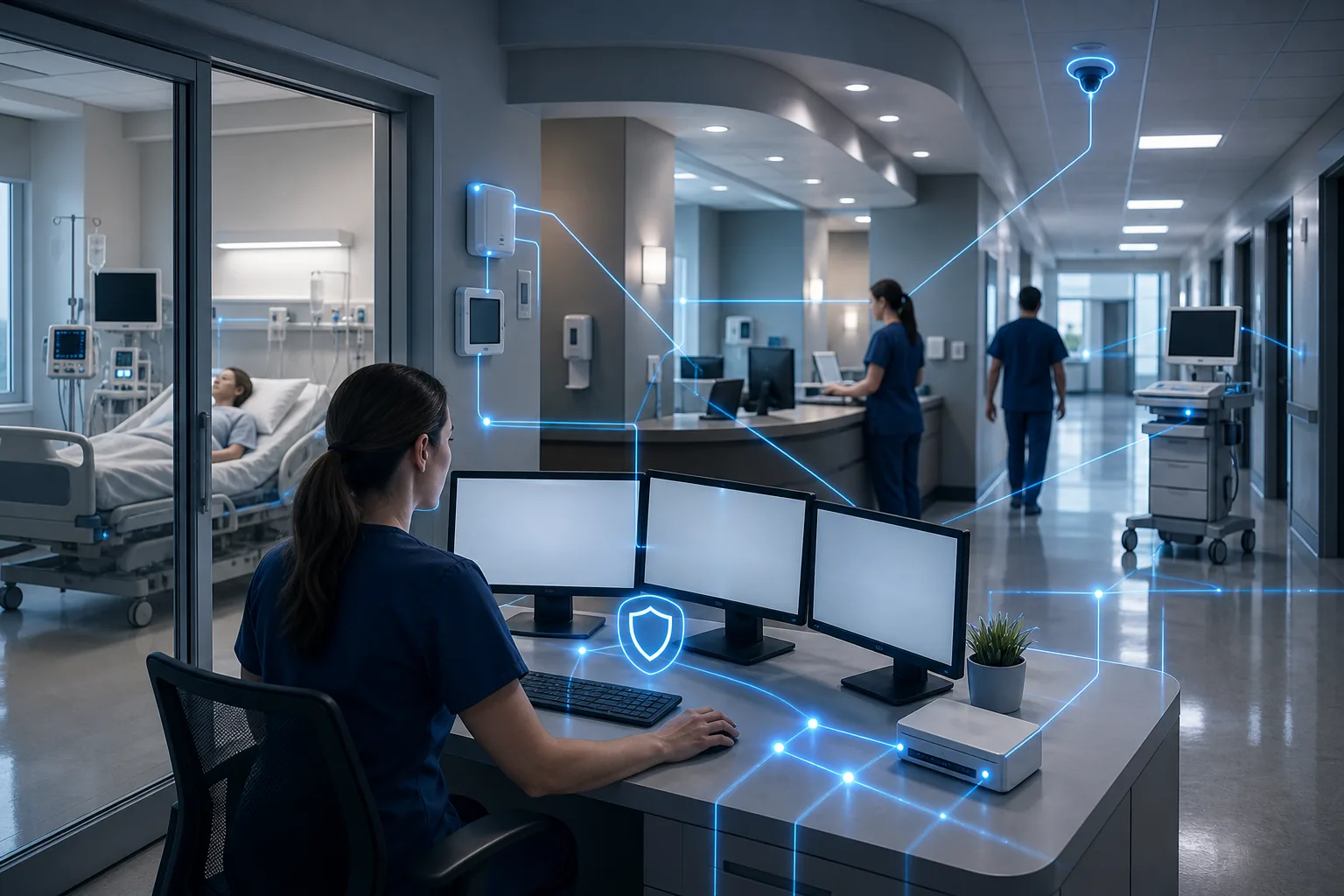
Monitoring gives healthcare providers a chance to act before a small account problem becomes a care outage. It should cover identity events, endpoints, servers, cloud tools, firewalls, and important medical devices.
Collect logs in one place. Track sign-ins, failed MFA attempts, privilege changes, new devices, unusual file access, malware alerts, and large data transfers. Set retention based on your risk assessment and legal duties. Logs help your team understand what happened after an alert.
Define alert rules that match your work. A login from a new country may need review. So may a service account accessing records at an unusual hour, or a user downloading far more files than their role requires.
Security Information and Event Management, or SIEM, brings events together for review. Managed Detection and Response, or MDR, adds people who investigate alerts and guide response. The technology matters, but the handoff matters more. Someone must know who receives the alert, who can isolate a device, and who tells clinical leadership.
AI can help sort large volumes of events and flag behavior that differs from a normal pattern. It can’t replace policy, skilled review, or a tested response plan. Poor data, bad rules, and unclear ownership can still produce missed alerts or wasted effort.
We recommend a daily review of high-risk alerts and a monthly review of trends. Look for repeated phishing attempts, unpatched systems, accounts with excess access, and vendors that miss required checks. Advatek’s 24/7 monitoring and managed IT services can give smaller healthcare teams a security operations layer without asking one internal employee to watch every system all night.
Set an escalation clock for serious alerts. The clock should cover technical response, executive notice, legal review, patient safety input, and any required regulator notice. A plan that lives only in a binder won’t help during a live event.
Step 4: Build Backups, Incident Response, and Disaster Recovery
Backups help healthcare providers recover after ransomware, hardware failure, accidental deletion, or a cloud outage. They work only when they are protected from the same event that harms the main system.
Start by naming the systems that care teams need first. Set a recovery time objective for each one. That means how long the service can be down. Set a recovery point objective too. That means how much recent data the organization can afford to lose.
Keep more than one backup copy. At least one copy should be offline or isolated from normal administrator accounts. Encrypt backup data in storage and in transit. Limit who can delete backups or change retention rules.
Test recovery on a schedule. Restore a sample patient record system, file share, application, or virtual server. Check whether the restored data is usable and whether staff know how to work during the outage. A backup that has never been restored is an assumption, not a recovery plan.
Write an incident response plan in plain language. Include the first actions for a suspected phishing event, ransomware alert, lost laptop, compromised account, and medical device concern. Name the decision makers and create a current contact tree without placing sensitive details in a public file.
During a suspected attack, preserve evidence before wiping systems when it is safe to do so. Isolate affected devices. Protect patient care first. Bring in legal and forensic support when the event may involve protected health information.
Plan for downtime procedures. Clinical staff need paper forms, medication workflows, patient identity checks, and a clear process for entering records after systems return. Home health teams may also need a way to verify visits and communicate when mobile systems are unavailable.
Advatek’s backup and disaster recovery services can help turn these requirements into scheduled backups, recovery tests, and documented procedures. The right setup still depends on your applications, recovery targets, contracts, and clinical needs.
Run a tabletop exercise at least once a year. Give the team a short scenario and ask what happens in the first hour. Record every delay. Those delays become your next work list.
Step 5: Train Staff, Manage Vendors, and Improve the Program
People are part of cybersecurity for healthcare providers because every role can touch sensitive data. Training should fit the job, repeat often, and lead to a clear action when someone sees a warning sign.
Teach staff how to spot phishing in email, text messages, and phone calls. Show them how to report a suspicious message without fear of blame. Explain why a shared account, copied patient list, or unlocked workstation creates risk.
Use short lessons during team huddles. Add examples from the organization’s own systems. Test the process with controlled phishing exercises only when leadership has approved the plan and follow-up training is ready.
Training should cover proper access levels. A worker who finds a way around an access rule may be trying to help, but the shortcut can expose patient data. Staff need a safe way to request access instead.
Review every vendor that can access systems or protected health information. Ask what data the vendor receives, where it is stored, who can access it, how incidents are reported, and whether the contract includes the required security terms. A signed agreement doesn’t replace ongoing review.
Set vendor review dates based on risk. A billing vendor with broad data access needs closer review than a supplier with no network connection. Recheck access after a contract ends and remove accounts that are no longer needed.
Use a scorecard that tracks open risks, patch age, MFA coverage, backup test results, training completion, alert response time, and vendor review status. These measures help leaders see progress without pretending that one score captures the whole program.
Use recognized healthcare cybersecurity practices to help teams turn broad duties into specific work. We also use healthcare cybersecurity guidance when building a plan for a provider’s size, systems, and risk level.
Advatek can take over day-to-day monitoring, patch management, compliance training, and AI-driven technology consulting while your leaders keep control of policy and risk decisions. Review the program each quarter, close the oldest high-risk gaps first, and update the plan after every incident or major system change.
FAQ
What is cybersecurity for healthcare providers?
Cybersecurity for healthcare providers is the set of safeguards that protects patient data, clinical systems, devices, and care operations. It includes access controls, MFA, patch management, monitoring, backups, staff training, vendor reviews, and incident response. The goal is to keep information private while helping care continue when a system fails or an attack occurs.
What are the biggest healthcare cybersecurity threats?
The main threats include ransomware, phishing, malware, stolen credentials, unpatched software, and vulnerable medical devices. A compromised account can expose patient records or spread through connected systems. Healthcare teams should also watch remote access, cloud services, vendor connections, and unmanaged devices because each adds another path into the environment.
Is HIPAA enough for healthcare cybersecurity?
HIPAA is a required foundation for many U.S. healthcare organizations, but it isn’t a complete security work plan. Providers should map HIPAA duties to a broader framework such as NIST CSF, then add state rules, contract terms, device needs, and business continuity controls. A qualified IT partner can help translate those duties into assigned tasks and evidence.
How often should healthcare staff receive security training?
Healthcare staff should receive security training regularly, with refreshers after major threats, policy changes, or repeated mistakes. Annual training may meet a minimum policy requirement, but short sessions during team meetings are easier to remember. Include phishing practice and clear reporting steps. Track attendance and route higher-risk users to extra coaching.
What should a healthcare incident response plan include?
A healthcare incident response plan should name the first technical actions, decision makers, clinical safety roles, legal contacts, communication steps, and reporting duties. It should cover ransomware, phishing, lost devices, account compromise, and medical device concerns. Test the plan with a tabletop exercise, then fix the delays that the exercise reveals.
Conclusion
Build your program in this order: know your risks, restrict access, watch the environment, test recovery, and train the people who use the systems. If your team lacks time or round-the-clock coverage, ask Advatek for a risk review and a managed plan that joins security monitoring with compliance work. Your next step is simple: list your five highest-risk systems and assign an owner to each.
Download Franchise Information Report
Want to learn more about opening your own franchise? Fill out this form to get started: