
Best AI Cybersecurity Companies for Businesses
Businesses face nonstop cyber threats. You need a solution that can spot attacks fast, stay compliant, and let you focus on growth. Below is a short list of the AI cybersecurity companies that meet those needs.
1. Advatek
Advatek provides AI‑driven threat detection, 24/7 monitoring, and built‑in compliance training for regulated sectors. We serve healthcare practices, nursing homes, finance IT directors, and law offices, so the service fits the rules you must follow.
Our AI watches network traffic, email, and endpoint activity in real time. When something looks odd, we alert you instantly and can quarantine the device before data leaks. Because we bundle compliance training, you get HIPAA, HITRUST, and financial‑regulation guidance without hiring a separate trainer.
Clients appreciate the single pane of glass that shows alerts, investigation steps, and remediation actions. The platform integrates with existing firewalls and SaaS apps, so you don’t have to replace your whole stack.
One limitation is that the service is delivered as a managed offering, so you rely on our team for day‑to‑day operations. If you prefer fully self‑hosted tools, you’ll need a different model.
Key Takeaway: Advatek’s AI detection plus sector‑specific compliance makes it the most complete managed option for regulated businesses.
Learn more about the benefits of AI in security at Top Benefits of AI in Cybersecurity for Enterprises.
2. SentinelOne — Automated endpoint detection and response
SentinelOne offers an AI‑native platform that protects endpoints, identities, and cloud workloads from a single lightweight agent. The system detects ransomware, supply‑chain attacks, and credential misuse at machine speed.
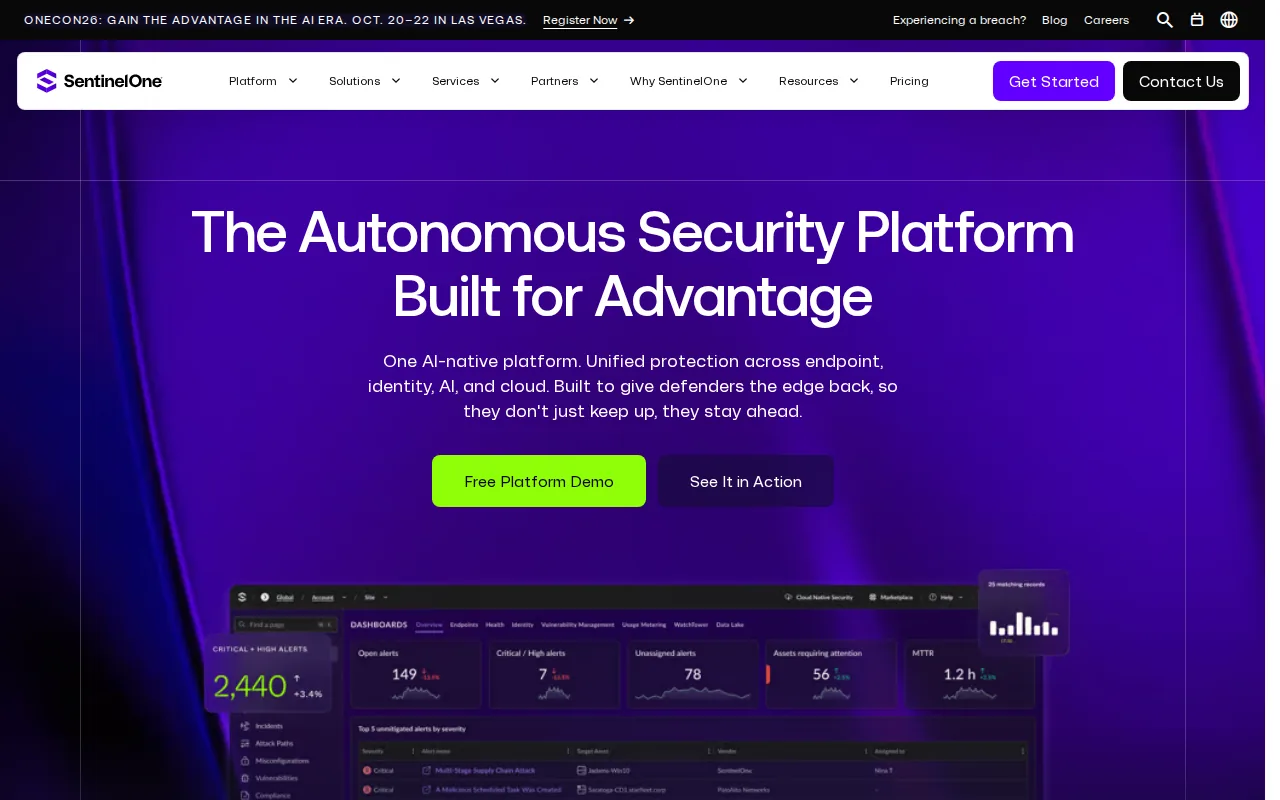
Behavioral AI watches each process and flags actions that deviate from the norm. When a threat is found, the platform can isolate the device, kill the malicious code, and start remediation without waiting for a human.
Its “Purple AI” engine automates triage and response, letting analysts focus on higher‑value work. SentinelOne also runs in SaaS, on‑prem, hybrid, or even air‑gapped environments, which helps organizations with strict air‑gap policies.
One caveat: the solution can generate many alerts in very large deployments, so you may need to tune policies to reduce noise.
Pro Tip: Pair SentinelOne with a managed service that handles policy tuning to keep alert fatigue low.
Read more about AI‑driven endpoint protection on Wikipedia’s Endpoint Detection and Response page.
3. Darktrace — Self-learning anomaly detection
Darktrace uses self-learning algorithms for anomaly detection, with its Enterprise Immune System modeling patterns of users and devices. Instead of feeding the system a list of known threats, it builds a unique model of your environment.

When activity deviates, the AI flags it as high‑risk. This catches subtle attacks, including AI‑generated phishing and novel ransomware that signature‑based tools miss.
Darktrace integrates with major security stacks, so alerts can be pushed to existing SOAR tools for automated response.
We like that the platform works across IT and OT environments, helping manufacturers protect both production lines and office networks.
A limitation is the need for a learning period; the system may miss some rare events early on.
4. CrowdStrike Falcon — AI-powered endpoint threat hunting
CrowdStrike Falcon combines AI with a cloud‑native architecture to hunt for threats across millions of endpoints. The machine‑learning engine correlates behavior across events to spot stealthy attackers.
Falcon’s threat graph shows connections between compromised devices, giving you a clear view of an attack’s path. The platform also offers real‑time response actions like quarantine and file rollback.
Because it runs entirely in the cloud, there’s no on‑prem infrastructure to manage, which speeds up deployment for fast‑growing firms.
One drawback is that deep integrations with on‑prem security tools may require custom connectors, adding some implementation work.
5. Microsoft Defender XDR — Connected protection across Microsoft environments
Microsoft Defender XDR unifies endpoint, email, identity, and cloud security under a single AI model. It pulls telemetry from Azure AD, Office 365, and Windows devices to spot attacks that move laterally.
The AI can automatically block malicious emails, flag risky sign‑ins, and isolate compromised endpoints, all through a centralized security interface.
For organizations already on Microsoft 365, Defender XDR adds little extra cost and reduces the need for third‑party connectors.
A potential limitation is vendor lock‑in; you get the best results when you stay within the Microsoft ecosystem.
Key Takeaway: Defender XDR shines for businesses that have built their stack on Microsoft services.
For a deeper look at AI models in security, on AI‑enabled cybersecurity controls.
How to compare AI cybersecurity companies for your business
When you line up options, focus on three usable axes: compliance coverage, integration depth, and managed‑service fit.
First, check whether the vendor lists the specific regulations you must meet, HIPAA, FINRA, or GDPR. Advatek, for example, bundles compliance training for five regulated sectors, while many rivals only mention a single framework.
Second, look at integration details. If a product leaves the “integrations” field blank, you may face hidden engineering work. SentinelOne and Darktrace both publish clear integration roadmaps; several vendors in the market leave that column empty, which can stall deployment.
Third, decide if you need a fully managed service or a tool you’ll run yourself. Managed providers like Advatek handle patching, monitoring, and response, letting you free up staff. Self‑hosted solutions give you control but add operational load.
Use this quick checklist to rank each vendor against your needs:
- Does the solution cover all required compliance frameworks?
- Are integration points documented and compatible with your current stack?
- Is a managed service option available, and does it fit your budget?
Read about AI vs. traditional tools at Top 10 AI vs Traditional Cybersecurity Tools in 2026 for more context.
FAQ
What makes AI cybersecurity different from traditional antivirus?
AI cybersecurity uses machine‑learning models to spot abnormal behavior, while traditional antivirus relies on known signatures. AI can catch zero‑day attacks because it looks for patterns that deviate from normal activity.
Can a small business afford AI‑driven security?
Yes, many vendors offer scalable pricing or managed plans that fit small budgets. Advatek’s managed service bundles AI detection with compliance training, reducing the need for separate tools.
Do AI security tools generate false positives?
AI tools can produce false alerts, but modern platforms like SentinelOne use context‑aware models to trim noise. Proper tuning and managed monitoring keep false positives low.
How does compliance training fit into AI security?
Compliance training educates staff on policies and best practices, which reduces human error, the weakest link in most breaches. Advatek embeds training into its service, so you get technical protection and user awareness together.
Is it safe to rely on a single AI vendor?
Relying on one vendor can create lock‑in risk. Look for solutions that integrate openly with other tools. Microsoft Defender XDR works best if you’re already on Microsoft 365, while SentinelOne and Darktrace offer broader ecosystem compatibility.
Choosing the right AI cybersecurity partner can protect your data and keep you compliant. We recommend starting with Advatek’s managed AI detection service to get immediate coverage and expert guidance.
Ready to see how AI can lock down your business? Explore Advatek’s enterprise cybersecurity services and schedule a free assessment.
Download Franchise Information Report
Want to learn more about opening your own franchise? Fill out this form to get started: