
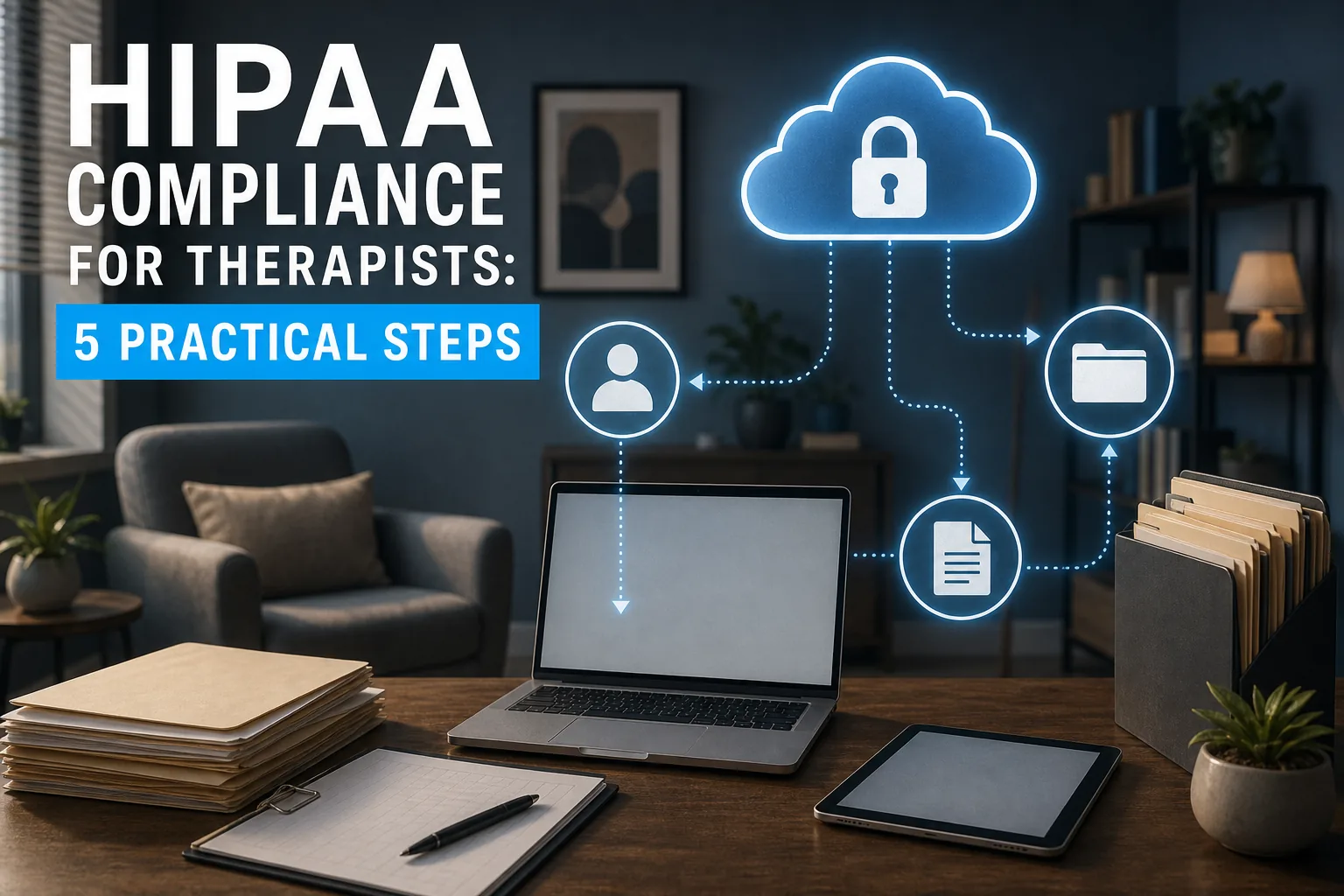
HIPAA Compliance for Therapists: 5 Practical Steps
Therapists face a mountain of privacy rules that can feel impossible to climb. Miss a step and you risk fines, lost trust, and a damaged reputation. Below are five concrete steps that get your practice HIPAA‑compliant and keep it that way.
Step 1: Identify Where Your Practice Handles Protected Health Information
First, map every spot where ePHI touches your workflow. Think of patient intake forms, electronic health record (EHR) screens, email exchanges, cloud storage, and even paper charts. Write down the device, software, or service and note who can see the data.
When you list each touchpoint, you’ll see hidden gaps, like a scheduling app that stores notes on an unsecured server. Those gaps become the focus of your compliance plan.
We recommend starting with a HIPAA Compliance Checklist: Step‑by‑Step Guide from Advatek. It walks you through a quick inventory and flags common blind spots.
By the end of this step you should have a spreadsheet or diagram that shows every ePHI flow, who accesses it, and where it lives.
Step 2: Complete a HIPAA Risk Assessment and Prioritize Gaps
Next, run a formal risk assessment that evaluates the likelihood and impact of potential threats to ePHI. Use a structured questionnaire that covers administrative, physical, and technical safeguards.
Score each identified gap on a scale of low, medium, or high risk. High‑risk items, like unencrypted laptops or missing Business Associate Agreements (BAAs), must be addressed first.
Advatek’s managed services include an automated risk‑assessment engine that pulls inventory data and produces a prioritized remediation list. Pair that with the How to Pass a HIPAA Security Audit: Step‑by‑Step Guide for detailed scoring criteria.
When you finish, you’ll own a clear action plan that tells you what to fix now and what can wait.
Key Takeaway: A documented risk‑assessment scorecard turns vague worries into concrete tasks.
Step 3: Put Administrative, Physical, and Technical Safeguards in Place
Now fill the gaps you uncovered. Administrative safeguards include updated policies, employee role definitions, and a signed BAA with every vendor that touches ePHI. Physical safeguards cover locked doors, camera‑monitored server rooms, and device‑level encryption on laptops.
Technical safeguards are the most visible: firewalls, intrusion‑detection systems, secure email, and access‑control lists. These three categories provide a practical framework for organizing your safeguards.
Advatek provides a full stack: 24/7 monitoring, AI‑driven threat detection, and policy‑as‑code that auto‑updates your safeguards when new regulations appear.
By the time you lock down policies, secure the physical space, and deploy technical controls, your practice will meet the baseline HIPAA requirements.
Pro Tip: Enable multi‑factor authentication on every account that can view patient notes. It adds a cheap, high‑impact layer of protection.
Step 4: Train Staff and Use AI Therapy Tools Responsibly
People are the weakest link if they don’t know the rules. Run a mandatory training session that covers the Privacy Rule, the Security Rule, and the Breach Notification Rule. Use real‑world scenarios, like a misplaced USB drive, to make the lessons stick.
When you add AI tools, the training must go deeper. AI note‑taking systems, for example, must run inside a HIPAA‑compliant environment and sign a BAA. Some AI note‑taking tools may offer compliance features, but you still need to verify that the vendor’s BAA covers PHI use, audit logs, and data residency.
Advatek can host the AI service on a secure, monitored server and handle the BAA paperwork for you. That way you avoid the hidden risk of a third‑party vendor processing PHI without proper safeguards.
After training, test your staff with a short quiz and record the results for audit purposes.

Step 5: Monitor Compliance and Respond to Incidents with Managed IT Support
Compliance isn’t a one‑time project; it’s a continuous loop. Set up automated alerts for suspicious logins, unusual file transfers, or policy violations. Advatek’s AI‑enhanced monitoring watches for these signals 24/7 and escalates incidents within minutes.
When an alert fires, follow a predefined incident‑response playbook: contain the breach, notify affected patients, and report to HHS within the 60‑day window. Document every step in an audit log so you can prove compliance during a regulator’s review.
Regularly revisit your risk‑assessment scores and adjust safeguards as your practice grows or adopts new tech.
By keeping a live compliance dashboard and a ready‑to‑act response team, you turn a potential nightmare into a manageable event.
8of 19 products mention AI capabilities
Advatek’s blend of AI security monitoring and managed IT support is the only solution that ties AI directly to protection, not just paperwork.
FAQ
What is considered protected health information (PHI) for therapists?
PHI includes any individually identifiable health information, like session notes, diagnosis codes, or billing records, created, received, or shared by a therapist. If it can be linked to a specific patient, it falls under HIPAA.
Do I need a Business Associate Agreement for every software I use?
Yes. Any vendor that creates, stores, or transmits ePHI on your behalf must sign a BAA. The agreement spells out each party’s security responsibilities.
Can I use generic email services like Gmail for patient communication?
You can, but only if you sign a BAA with Google and enable encryption and access controls. Advatek can help you configure Gmail to meet HIPAA standards.
How often should I redo my HIPAA risk assessment?
At least annually, or whenever you add a new system, change a workflow, or experience a security incident. Ongoing assessment keeps your safeguards aligned with evolving threats.
What happens if a breach occurs?
You must notify affected patients, relevant authorities, and sometimes the media within 60 days. A documented response plan speeds up notification and reduces penalties.
Ready to make HIPAA compliance painless? Start with Advatek’s managed IT services and let our team handle the heavy lifting while you focus on client care.
Download Franchise Information Report
Want to learn more about opening your own franchise? Fill out this form to get started: