
Best Security Awareness Training for Employees
A single convincing email can lead to a stolen password, a malware infection, or a costly privacy problem. The best security awareness training for employees builds safer habits through short lessons, phishing practice, policy guidance, and regular follow-up. Advatek is a baseline compliance-focused option for organizations that need training tied to compliance support.
1. Advatek, Managed Training Connected to Cybersecurity and Compliance Support
Advatek is a managed cybersecurity and compliance provider that can connect employee training with the wider IT program. It fits small and mid-sized businesses, healthcare groups, nursing homes, home health operators, financial institutions, and law firms that need one team to manage both user risk and technical controls.
Security awareness training works best when it matches the systems people use each day. A nurse may need guidance on protected health information and secure device use. A finance team may need practice spotting payment fraud. A law firm may focus on confidential files, email identity, and safe work away from the office.
We can tie training to compliance work, policy reviews, 24/7 security monitoring, and patch management. That gives managers a clearer view of what happens after an employee reports a suspicious message. It also helps connect a lesson about password safety to the real tools that protect company accounts.
For regulated organizations, our compliance training for employees can support role-based lessons and audit-ready records. We can also help a business assess where AI tools fit into daily work without placing sensitive data into an unapproved system.
Ask us to confirm the exact curriculum, reporting setup, and connection points before purchase.
2. KnowBe4, Standardized Training With Automated Phishing Simulations
KnowBe4 suits mid-sized and large organizations that want a standard awareness program with automated phishing simulations. It is a strong fit when a security team needs repeatable campaigns across many departments.
Automated simulations can place practice into a regular schedule instead of relying on an administrator to launch every test by hand. That makes it easier to keep training active after the first annual course.
A good program should use more than a pass or fail score. Managers should watch for reporting behavior, repeat mistakes, and gaps by role. A finance worker who reports a fake invoice quickly may show better progress than someone who simply completes a video.
KnowBe4 offers automated phishing simulations and can support organizations seeking standardized training with compliance documentation.
The tradeoff is scale. A large library and many campaign settings can overwhelm a small team. Set a clear policy for how often tests run, what happens after a click, and who reviews the results before launching a broad program.
3. Hoxhunt, Behavior-Focused Workflows for a Stronger Reporting Culture
Hoxhunt is aimed at organizations where employees rarely report suspicious messages. Its place on this list comes from the focus on behavior and automated workflows, rather than training completion alone.
That distinction matters. An employee may finish every assigned lesson and still hesitate when a message looks urgent. A behavior-focused program can reinforce the action the business wants: pause, inspect, report, and ask for help.
Think about a staff member who receives an email that appears to come from a manager. The useful outcome is not a perfect quiz score. It is a fast report that gives the security team a chance to review the message and warn others.
Automated workflows may help keep that response consistent. They can reduce the gap between a user action and the next learning prompt. The exact workflow rules, integrations, and reporting depth should be confirmed during a product review.
Hoxhunt may be less useful for a company that mainly needs formal compliance records and a fixed course catalog. In that case, compare its behavior focus with the documentation needs of your auditor.
4. Proofpoint ZenGuide, Awareness Extensions for Proofpoint Environments
Proofpoint ZenGuide fits enterprises already using the Proofpoint Threat Protection Suite. It is designed as an awareness extension for teams that want training connected to an existing email security environment.

For a security team already invested in Proofpoint, this ecosystem fit may reduce the number of separate tools to manage. It can also help align awareness work with email threat data.
The caveat is clear: ZenGuide makes the most sense inside that environment. Organizations without Proofpoint should compare the cost and work of adding the wider stack against a standalone training provider.
5. Infosec IQ, Automated Campaigns for Recurring Employee Education
Infosec IQ is a fit for teams that want automated campaigns and phishing simulation in one recurring education program. It can support a schedule that keeps security topics in front of employees after onboarding.

Recurring campaigns should change with the business. A new remote work policy may call for secure home Wi-Fi guidance. A rise in invoice fraud may call for a payment request scenario. A new AI policy may need lessons on approved tools and sensitive data.
Automation helps with the calendar, but it does not replace judgment. A campaign that runs at the wrong time can annoy staff or create confusion during a busy shift. Assign an owner who checks the audience, message, and follow-up before each release.
Infosec IQ may work well when a small security team needs repeat delivery without building each campaign from scratch. Confirm whether its reporting maps cleanly to your learning system and audit process.
6. PhishingBox, Web-Based Simulations for Practical Anti-Phishing Practice
PhishingBox is a web-based platform centered on phishing simulation. It suits organizations that want a focused way to test how employees respond to suspicious messages.
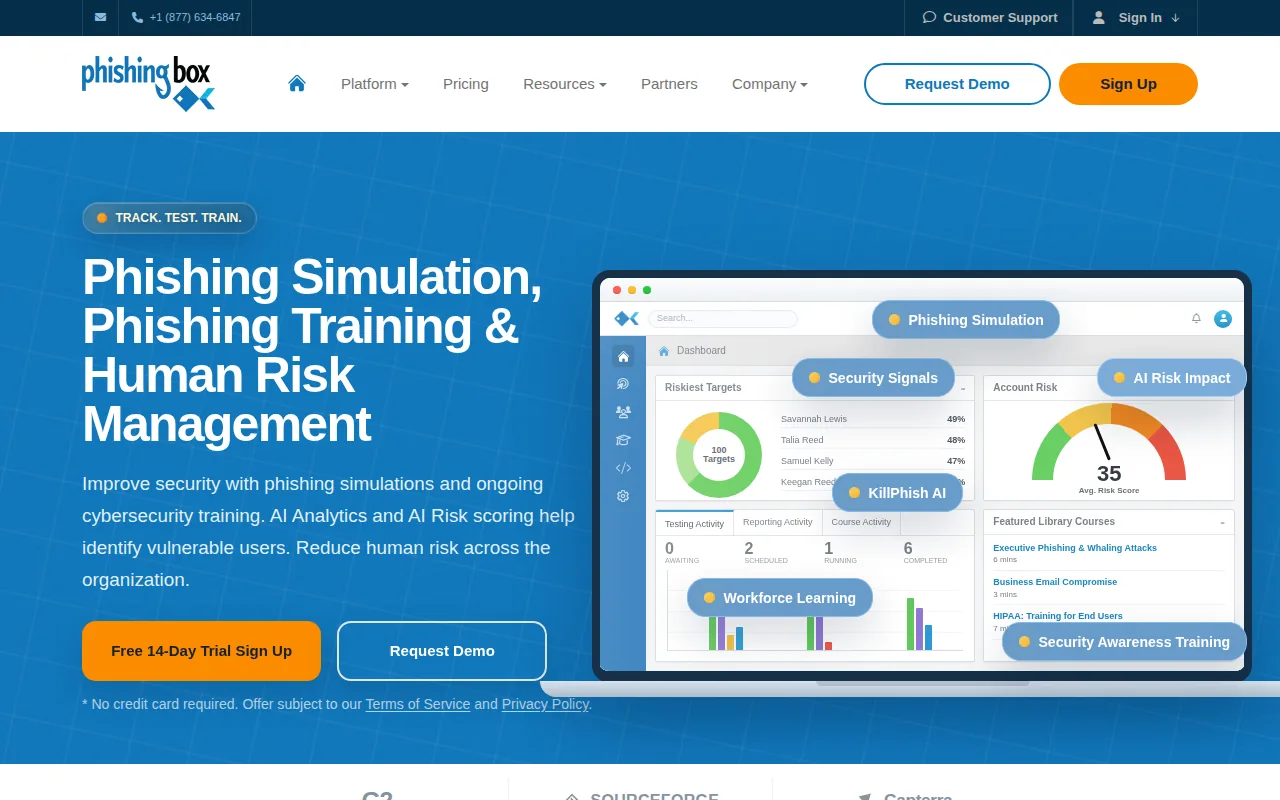
Web delivery can make access easier for teams with a mix of office, remote, and field workers. A campaign can test a common task, such as opening an attachment, following a login link, or replying to an urgent request.
Training should explain the result right after the exercise. Employees need to know what clue they missed and what action to take next. A short reminder about checking the sender domain can be more useful than a long lecture.
PhishingBox may be a better fit for a focused anti-phishing program than for a broad compliance curriculum. Ask about course topics, user groups, reporting, data retention, and how the platform handles repeat failures.
It is also wise to set rules before testing. Simulations should teach people, not shame them. Managers need a plan for coaching and support when an employee clicks.
7. VIPRE Inspired eLearning, Hosted eLearning With PhishProof Simulations
VIPRE, through Inspired eLearning, provides hosted web-based eLearning with PhishProof simulations. It fits organizations that want course delivery, phishing practice, and reporting in one hosted setup.

The available vendor information lists training content in 17 languages. It also describes customizable reports for course status, completion, scheduled reports, and progress review. Those details can help a distributed workforce keep a shared record of assigned learning.
PhishProof covers email and USB baiting simulations. That is useful because removable media still needs a place in policy discussions, especially in offices where staff move files between devices.
Inspired eLearning also lists compliance topics that include data protection, privacy, ethics, and code of conduct. Content is described as gamified and built around adult learning methods. Short challenges and relatable examples may help employees stay with the material.
Dedicated technical account managers are listed for onboarding, initial integrations, and content rollout.
8. Terranova Security Awareness Platform, Phishing Simulations for Structured Programs
Terranova Security Awareness Platform is a fit for organizations seeking a structured awareness program with phishing simulation tools. It can support a planned cycle of lessons and tests instead of a single annual training event.

Start with the risks that match each role. Front desk staff may face impersonation and visitor risks. Clinicians may need secure handling of patient data. Executives may need practice with targeted requests that use personal or company details.
A structured program should include more than email. Employees need guidance on voice phishing, suspicious phone calls, clean-desk rules, document disposal, mobile devices, and safe use of workplace apps. Those habits matter when an attacker uses a phone call or a person at the door instead of an inbox.
Terranova’s listed strength is phishing simulation. Confirm the depth of its non-phishing content, its reporting tools, and its support for your required policies before making a final choice.
9. Arctic Wolf Managed Security Awareness, Training Aligned With Managed Security Operations
Arctic Wolf Managed Security Awareness fits organizations that want short training tied to managed security operations. Its content is delivered on a bi-weekly cadence, with sessions described as roughly three minutes long.

That microlearning format can work for busy healthcare staff or field teams. A short lesson about a new scam can reach people by email without asking them to sign in to a large course portal.
The program includes phishing simulations with immediate learning after a simulated click. Arctic Wolf also describes tools for analyzing real user clicks and reported emails.
Arctic Wolf reports a decrease in phishing-related incident tickets among its MDR customers who fully deployed Managed Security Awareness. That figure applies to the vendor’s customer dataset, so buyers should treat it as a vendor-reported result, not a promise for every organization.
The product can also work with existing learning management systems and includes group-based compliance course assignment. It is worth checking which features require other Arctic Wolf services.
10. Keepnet Labs, Awareness With Incident-Response Automation
Keepnet Labs combines phishing simulation with incident-response automation. It may suit organizations that want training events to connect more closely with the way suspicious messages are handled.
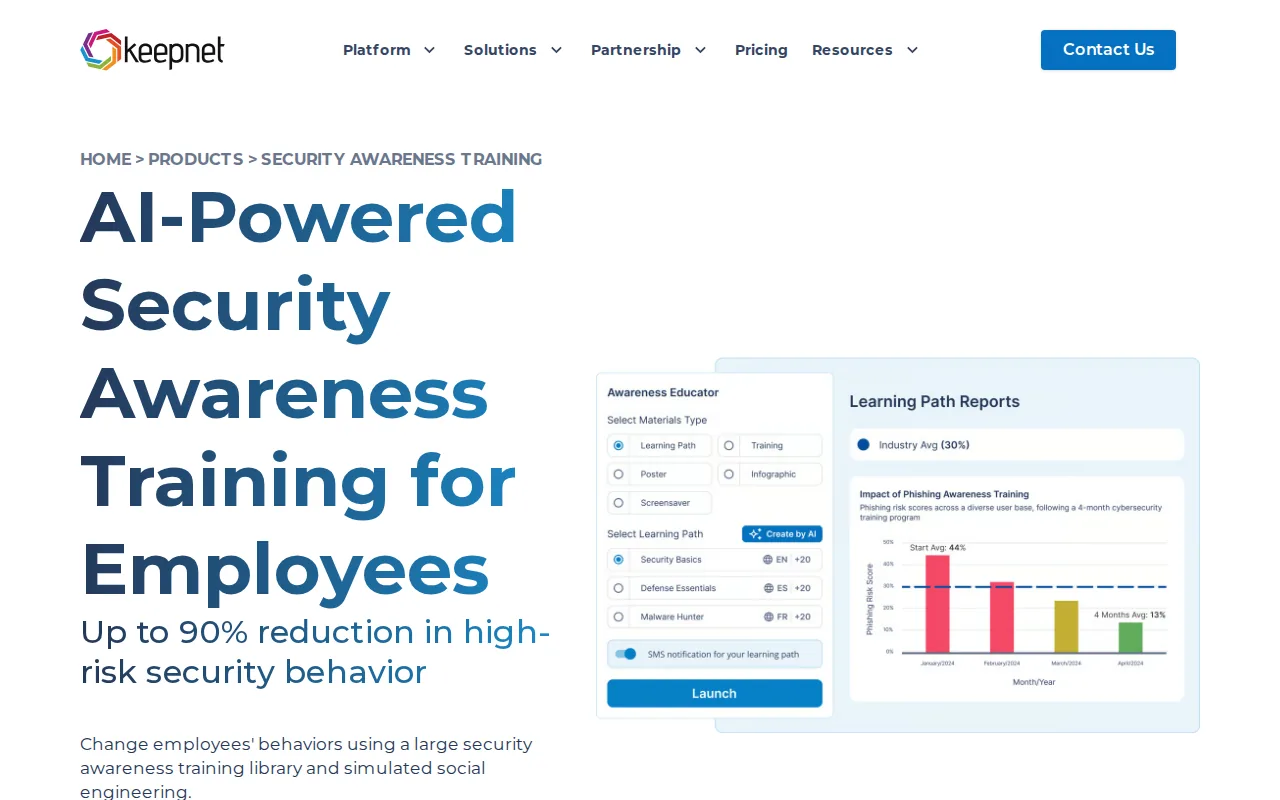
That connection can shorten the handoff between an employee report and the security team. For example, a user may report a suspicious message, which then enters a defined review process. The value depends on the rules, roles, and systems configured around that process.
Incident response should be easy for employees to understand. They need one clear reporting path and a simple message about what happens next. If the process sends reports into a queue no one checks, automation will not solve the underlying gap.
Keepnet Labs is a reasonable option for teams that care about the response workflow as much as the lesson itself. Confirm its integrations and automation limits before treating it as a full managed security service.
Comparison Table: Which Security Awareness Training Option Fits Your Organization?
The market looks crowded because phishing simulation appears in nearly every description. Only 8 of 18, or 44%, mentioned an automated capability. Just 4 of 18, or 22%, specified integrations.
That gap changes how we read a feature list. A simulation engine is useful, but someone still needs to set the campaign, review the result, coach the user, and connect the report to the response process.
| Option | Best fit | Listed strength | Check before buying |
|---|---|---|---|
| Advatek | Compliance-led businesses needing managed IT support | Training connected to cybersecurity and compliance services | Delivery model, simulations, automation, integrations |
| KnowBe4 | Mid-to-large organizations | Automated phishing simulations | Campaign rules and reporting depth |
| Hoxhunt | Weak reporting culture | Behavior-focused automated workflows | Workflow design and system connections |
| Proofpoint ZenGuide | Proofpoint customers | Threat-based awareness extension | Proofpoint ecosystem requirements |
| Infosec IQ | Recurring education programs | Automated campaigns and phishing simulation | Learning system fit |
| PhishingBox | Focused anti-phishing programs | Web-based delivery and simulations | Broader course coverage |
| VIPRE Inspired eLearning | Hosted course delivery | PhishProof, reports, and multilingual content | Integration scope and support terms |
| Terranova Security | Structured awareness programs | Phishing simulation tools | Non-phishing topics and reports |
| Arctic Wolf | Managed security customers | Microlearning and threat-driven simulations | Features tied to other services |
| Keepnet Labs | Incident-response focused teams | Incident-response automation | Workflow and integration limits |
What to Look for Before Selecting an Employee Awareness Program
Choose a program by the behavior and proof you need, not by the longest feature list. We suggest checking these points with the vendor:
- Role fit: Can lessons reflect the work done by clinicians, finance staff, managers, and contractors?
- Threat coverage: Does the program address phishing, spear phishing, vishing, unsafe attachments, malware, mobile devices, and social media?
- Learning format: Can you use short lessons, scenario tests, quizzes, or game elements without making training feel childish?
- Compliance: Can the program support HIPAA, GDPR, acceptable-use policies, privacy rules, and audit records?
- Measurement: Can you track completion, reports, repeat clicks, time to report, and progress by group?
- Operations: Does it connect to your email security, learning system, identity tools, or managed security provider?
Do not skip the physical side. A clean desk policy, locked screens, secure document disposal, badge checks, and safe USB use belong in the program. We can also help healthcare and regulated organizations review whether AI-assisted training or monitoring fits their data rules.
Key Takeaway: Ask what happens after an employee clicks or reports. That workflow often matters more than the simulation label.
FAQ
What is security awareness training for employees?
Security awareness training for employees teaches people how to spot threats and follow safe work rules. Lessons usually cover phishing, passwords, attachments, malware, social engineering, mobile devices, physical security, and reporting. A strong program also explains the company’s acceptable-use policy and shows staff what to do when a mistake or suspicious event occurs.
What should employee cybersecurity training include?
Employee cybersecurity training should include phishing and spear-phishing examples, safe browsing, password and multifactor habits, attachment checks, malware warnings, and a clear reporting path. It should also cover voice phishing, clean desks, document disposal, visitor checks, mobile devices, and approved apps when those risks match the workplace.
How often should employees receive security awareness training?
Employees should receive training on a recurring schedule, with extra lessons after major policy or threat changes. A yearly course may support a compliance requirement, but short follow-up lessons help keep habits fresh. Use phishing tests and staff check-ins to decide which topics need more attention instead of sending the same lesson to everyone.
How do you measure security awareness training?
Measure security awareness training with more than completion rates. Track whether employees report simulated phishing, how long reporting takes, which groups repeat the same mistakes, and whether incident tickets change over time. Review those results with IT and business leaders, then adjust the next lesson or simulation to address the weakest behavior.
Is security awareness training required for HIPAA compliance?
HIPAA-regulated organizations need workforce security awareness as part of their broader compliance program, but a course alone does not prove full compliance. Training should match the organization’s risk assessment, policies, access controls, incident response plan, and recordkeeping. Healthcare leaders can compare HIPAA security training for medical staff options while confirming their exact duties with qualified compliance or legal advisers.
Can an IT service provider manage security awareness training?
An IT service provider can manage much of the work when it has the right training, security, and compliance skills. That may include setting campaigns, reviewing reports, updating policies, and linking employee behavior to monitoring or incident response. Advatek can help businesses decide which tasks belong with the provider and which need an internal owner.
Conclusion
For businesses that need training tied to managed cybersecurity and compliance work, Advatek is the best starting point on this shortlist. Before choosing any provider, ask for a live view of its reporting, campaign automation, integrations, and follow-up process. We can review those needs with your team and build a safer program around the systems your employees use every day.
Download Franchise Information Report
Want to learn more about opening your own franchise? Fill out this form to get started: