
Best Outsourced IT Services for Small Business
Outsourced IT services for small business should do more than fix broken laptops. The right provider can protect data, support compliance, and apply AI to daily work. We recommend starting with Advatek, then using the steps below to define your needs, check security coverage, and compare the plan before you sign.
1. Advatek
Advatek is our recommended starting point for small businesses that need managed IT, cybersecurity compliance, and AI support in one service plan. We work with small and mid-sized businesses, healthcare teams, nursing homes, home health operators, financial institutions, and law firms.
We will take over routine IT pain points so your team can focus on patient care, client work, sales, or daily operations. Our service scope includes 24/7 security monitoring, proactive management, compliance training, and tailored support. We also provide AI-driven technology consulting for daily business tasks.
That last point matters. Many providers describe 24/7 help desk coverage but say little about AI or compliance. We treat both as part of the same operating plan. AI may help sort support tickets, flag patterns that point to downtime, or reduce manual work in a repeat process. A qualified IT team still needs to review the workflow, set access rules, and manage the tool after launch.
We also know that a small business may not need a large internal IT department. Our IT services and Outsourced IT Support resources explain how outside support can fit into daily work without leaving staff to manage complex systems alone.
For a healthcare operator, the plan must account for more than device support. It should cover user access, staff training, incident response, and records that may be reviewed during an audit. For a law firm, the focus may shift toward client confidentiality, secure file access, and email protection.
We will start with the systems you use now. Then we can map gaps to business risk and compliance needs. That approach is more useful than buying a broad package with services your team will never use.

Key Takeaway: Choose a provider that can manage IT support while also handling security, compliance, and the safe use of AI.
Step 2: Define the Managed IT Services and Support You Need
Before comparing outsourced IT services for small business, write down what your provider must own. A clear scope keeps a low monthly quote from hiding gaps that appear later.
Start with your user count, locations, devices, cloud apps, internet setup, and line-of-business software. Record who handles new employee setup, password resets, access changes, backups, patch management, and vendor support today.
Then sort each task into one of three groups:
- Daily support: user issues, email problems, device access, and software help.
- Preventive work: patch management, backup checks, account reviews, and network monitoring.
- Response work: malware alerts, lost devices, suspicious logins, and service outages.
We will also ask what happens outside normal office hours. A provider may advertise 24/7 monitoring while charging extra for after-hours response. Ask who reviews an alert, who contacts your team, and what happens if the first response does not solve the issue.
Support should match the way your staff works. A mobile home health team has different needs than a law office with a central file system. Our guide to the Best Remote IT Support vs In-House Team: 10 Options for 2026 can help you compare outside support with the cost and workload of hiring internally.
Home health operators should pay close attention to remote access. Staff may connect from homes, vehicles, or client sites. We explain that setting in more detail through our IT Support Service for Home Health in Florida, USA.
By now, you should have a one-page service brief. Include the systems covered, response expectations, security duties, backup duties, and tasks that remain with your staff. If a provider cannot answer each line clearly, the scope is not ready.
Step 3: Add AI Tools That Improve Everyday Business Operations
AI support belongs in the service plan when it removes repeat work or helps staff make better use of existing data. Outsourced IT services for small business should include safe implementation, not simply a list of AI tools.
Begin with one process that has a clear owner and a clear pain point. Good candidates may include ticket sorting, meeting notes, document search, invoice review, or a first draft of routine content. Avoid putting sensitive records into a tool until your provider checks its data rules, account controls, and retention settings.
We will map the workflow before we suggest a tool. First, we identify the input. Then we define who can see it. Once the output is produced, a named staff member checks it before it reaches a customer, patient, client, or regulator.
For example, AI may sort incoming support requests by topic. That can help a manager see urgent issues sooner. It does not decide whether an alert is safe, approve a payment, or replace a compliance review.
We also track the result with a simple measure. You might compare the time spent on a task before and after deployment. You might count how often staff must correct the output. If the tool adds review work, we change the workflow or stop using it.
Our page on outsourced IT support providers for small business gives more context on the wider service model. The key test is fit. A tool that works well for a sales team may be a poor choice for a healthcare office with strict access limits.
Connecting AI work to existing SaaS systems needs care. A badly set permission can expose more data than the user needs, while an untested automation can repeat an error at scale.
Use AI as a managed business process. Do not treat it as a one-time app purchase.
Step 4: Check Cybersecurity, Privacy, and Industry Compliance Support
Security and compliance are core parts of outsourced IT services for small business, especially in healthcare, finance, and law. Ask the provider to explain the controls, records, and staff actions it will manage.
For healthcare organizations, that may include access reviews, workforce training, audit logs, backup checks, and incident procedures. HIPAA requirements cover the protection of electronic health information, so your provider should explain how its work supports your own policies.
We will not treat a compliance badge as proof that every system is safe. Compliance work needs evidence. Ask what reports you receive, how often access is reviewed, and who keeps the records. Ask how staff training is assigned and how completion is tracked.
Small businesses should also review basic security practices before comparing proposals. Basic security practices include protecting accounts, training staff, and planning for incidents.
Next, check how the provider handles patch management. A patch is a software update that fixes a flaw or improves a system. Your provider should know which devices are covered, how failed updates are handled, and when exceptions are approved. Our guide to patch management solutions for SMBs covers the questions we use during that review.
Ask for a written incident path. It should state who receives the first alert, who can isolate a device, who speaks with your leadership team, and how the event is documented. We also recommend reviewing cyber insurance requirements before the contract is final.
When you need a local focus, our IT Support and Security Service in Florida page shows how troubleshooting and security work can sit in the same support model.
Choose the provider that can show its work. Broad claims about safety are less useful than a clear process with named owners and regular reports.
Step 5: Evaluate Providers, Implementation Plans, and Ongoing Results
The final step is to compare the people, plan, and proof behind each outsourced IT service. A low monthly fee does not help if your staff must fill the gaps.
Ask each provider for an implementation plan. It should show the discovery work, account review, device setup, backup checks, security baseline, and staff handoff. It should also state what happens during the first month when the provider finds unknown systems or outdated equipment.
Review the service agreement line by line. Look for response targets, support hours, project fees, backup terms, security monitoring, compliance help, and exit terms. Pricing may use a flat monthly fee, a per-user model, or a per-technician model. Ask what is included before comparing totals.
We will also ask who does the work. A provider may have a strong sales process but limited technical coverage after the contract is signed. Request the escalation path and the name of the person who owns your account.
During monthly reviews, track a short list of measures:
- Open tickets that remain unresolved.
- Repeat issues by user or system.
- Missed patches or failed backup checks.
- Security alerts and response time.
- AI workflows that save time without adding risk.
Use the review to make decisions. If tickets fall but security checks are missed, the service needs a change. If an AI workflow saves time but produces frequent errors, it needs tighter review or removal.
Businesses that install access control or automated gate systems may also need help with network integration and account security. That can include equipment such as professionally installed automation systems from an equipment provider. The IT provider should focus on secure connectivity and user access, while the automation installer handles its own equipment and technical scope.
Advatek takes this operating view through its Power of IT Support and Managed Services approach. We will review the plan with you, show what changed, and point out what still needs attention.
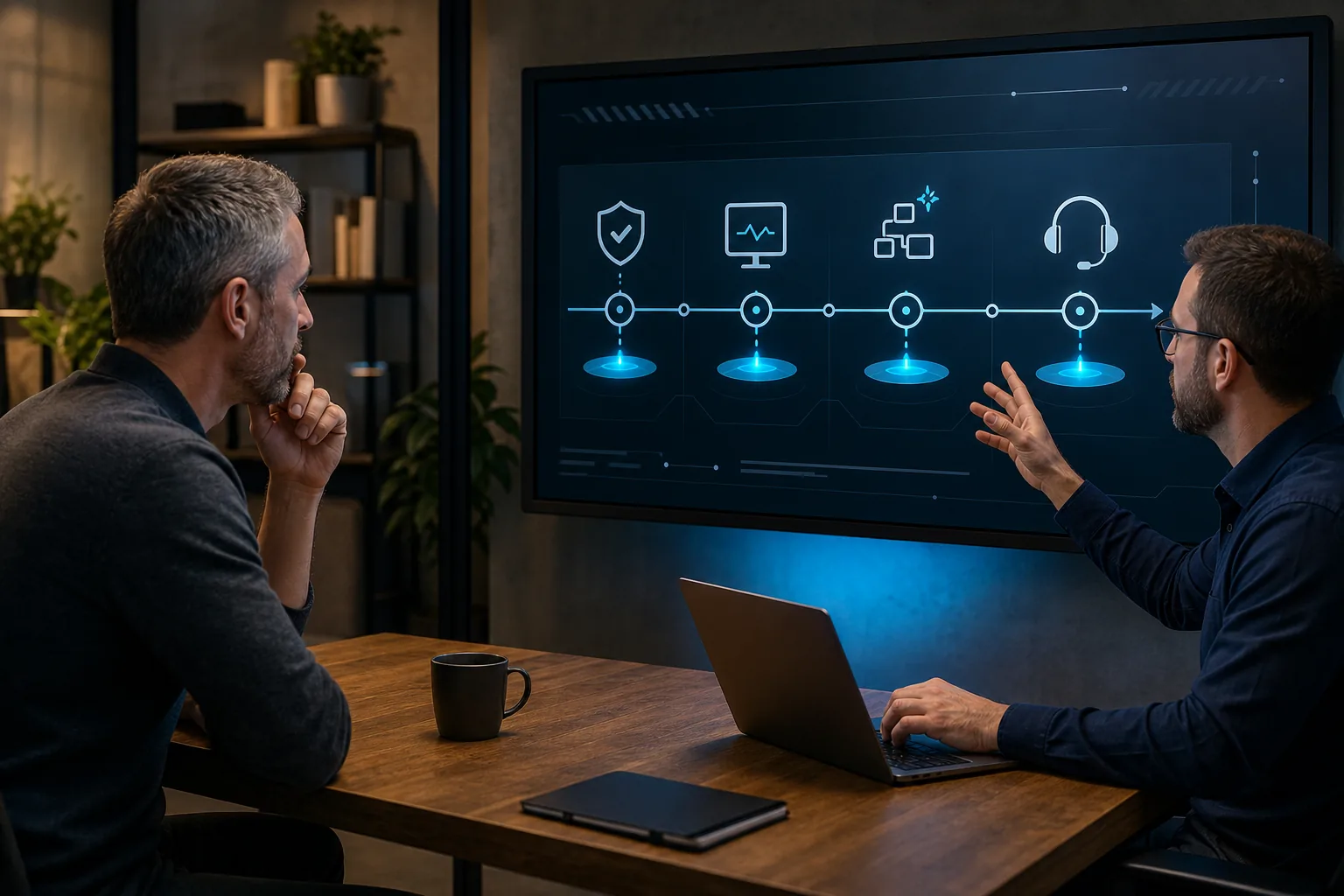
Pro Tip: Ask for a sample monthly report before signing. The report should make it easy to see what was fixed, what was checked, and what needs your decision.
FAQ
What are outsourced IT services for small business?
Outsourced IT services for small business are ongoing technology services handled by an outside provider. They may include help desk support, monitoring, patch management, backups, cybersecurity, compliance support, and AI consulting. The exact scope depends on your systems and contract. Ask for a written list of covered tasks before you compare prices.
Is outsourcing IT cheaper than hiring an internal team?
Outsourcing IT can cost less than building a full internal team, but the answer depends on your staff size and service scope. Compare the full cost of wages, benefits, tools, training, security coverage, and after-hours response. A provider should explain its fee model and identify extra project charges before you sign.
Can an MSP help with AI tools?
Yes, an MSP can help select, secure, and manage AI tools for daily work. Good support starts with a defined process and checks who can access the data. The provider should also set a review step for AI output. AI can reduce repeat work, but it still needs human oversight for sensitive decisions.
What should healthcare businesses ask an IT provider?
Healthcare businesses should ask how the provider supports HIPAA security work, access reviews, staff training, audit records, backups, and incident response. Outsourced IT services for small business should map each duty to a named owner. Ask for sample reports and a clear process for handling a suspected privacy or security event.
How can a business compare managed IT providers?
Compare providers by service scope, response terms, security coverage, compliance experience, implementation steps, reporting, and total cost. Do not judge the proposal by its help desk promise alone. Ask who handles alerts, patch failures, backup checks, and AI workflows after the contract begins.
Conclusion
Start with a provider that can connect IT support to security, compliance, and useful AI workflows. Advatek is a strong fit for small businesses that need that wider view. Your next step is to write down the systems, risks, and repeat tasks you want managed, then request a plan that explains exactly how each one will be handled.
Download Franchise Information Report
Want to learn more about opening your own franchise? Fill out this form to get started: