
AI Incident Response: How It Works and Where It Fits
AI incident response lets you spot and stop AI‑related attacks before they cause real damage. It blends machine learning, automation, and human oversight into a single workflow. Below we break down what it means, how the tech works, where it adds value, and what risks you still need to manage.
What AI Incident Response Means
At its core, AI incident response is a formal set of steps that guide an organization through recognizing, containing, and fixing problems that stem from AI systems. Those problems can be cyber‑attacks on a model, data‑poisoning, biased outputs, or even an AI that behaves erratically on its own. The goal is to limit harm, keep compliance intact, and learn enough to prevent a repeat.
Traditional incident response plans already cover many of the same phases, detection, analysis, containment, eradication, recovery, and post‑mortem. AI adds new failure modes, so the plan must also address model integrity, prompt‑injection attacks, and the need to capture transient artifacts like prompts, token logs, and model states.
Our managed AI‑driven incident response service builds on the same framework you see in our Incident Response Services. We add AI‑specific telemetry, automated triage, and compliance checks that map to HIPAA, PCI, and other regulations that matter to regulated midsize firms.
Key elements include an inventory of all AI assets, continuous monitoring for abnormal behavior, and a playbook that tells both the AI agents and the human team what to do when a breach is detected.
Key Takeaway: AI incident response expands a classic response plan with model‑focused detection and remediation steps.
How AI Supports Detection, Investigation, and Response
AI shines at three stages: spotting threats fast, pulling together the right data, and automating low‑risk actions.
First, AI‑enabled sensors scan logs, model performance metrics, and API usage in real time. When an anomaly spikes, for example, a sudden surge in token requests from an unknown IP, the system flags it and assigns a confidence score. AI tools can help prioritize alerts and gather relevant context for review.
Next, the AI builds an investigation timeline. It gathers logs from the SIEM, enriches indicators with threat feeds, and maps activity to relevant guidance like security operations practices. The result is a single, human‑readable narrative that shows exactly which model endpoint was hit, what data was accessed, and which downstream services were affected.
Finally, for actions that are clearly reversible, such as revoking a compromised API token or isolating a single container, the AI can execute the step automatically. More destructive moves, like rolling back a production model, still require a human sign‑off. This split‑decision model keeps speed high while protecting critical assets.
A qualified IT service company can help manage this process, so analysts can focus on reviewing the AI’s reasoning and approving high‑impact changes.
Where AI Incident Response Can Help Businesses
Healthcare providers, law firms, and financial institutions all run AI models that handle sensitive data. A misstep can trigger privacy breaches, regulatory fines, or even physical harm.
In a hospital, an AI that triages patient intake could be fed corrupted data, leading to wrong priority flags. Rapid detection and rollback prevent the error from reaching clinicians. In a law firm, a language model that drafts contracts might generate biased language. An AI incident response playbook can isolate the model, scrub the training set, and re‑train with corrected data before any client document is sent.
For midsize firms, the biggest win is cost‑effective coverage. Our AI Threat Detection Services for Business give you 24/7 monitoring without the need to hire a full‑time AI security team. The service ties into your existing SIEM, so you get a unified view of both traditional threats and AI‑specific signals.
When you combine AI detection with a managed response platform, you also get built‑in compliance reporting. The system can generate the audit logs required by HIPAA or the SEC, turning a chaotic incident into a clean, documented process.
Pro Tip: Map each AI asset to a specific compliance requirement (HIPAA, GDPR, etc.) in your risk register. That way the incident response playbook knows which regulations to notify automatically.
Risks, Limits, and Human Oversight
AI is powerful, but it is not a silver bullet. Mis‑configurations, data drift, and over‑reliance on confidence scores can all lead to false sense of safety.
One common pitfall is granting an AI too much autonomy. A safe rule is to let AI agents act only on reversible steps unless a person with the right authority approves. Giving an AI the ability to delete production data without a human check can amplify damage instead of containing it.
Model bias can go undetected, so human review remains important, especially for decisions that could affect patient safety or legal outcomes. A qualified IT service provider can help assess these risks and establish appropriate oversight.
Finally, AI accuracy can vary. Automated triage may be less reliable with unusual alerts or custom detection logic, and some incidents may still require manual analysis. That’s why a blended approach, AI for speed, humans for judgment, works best.
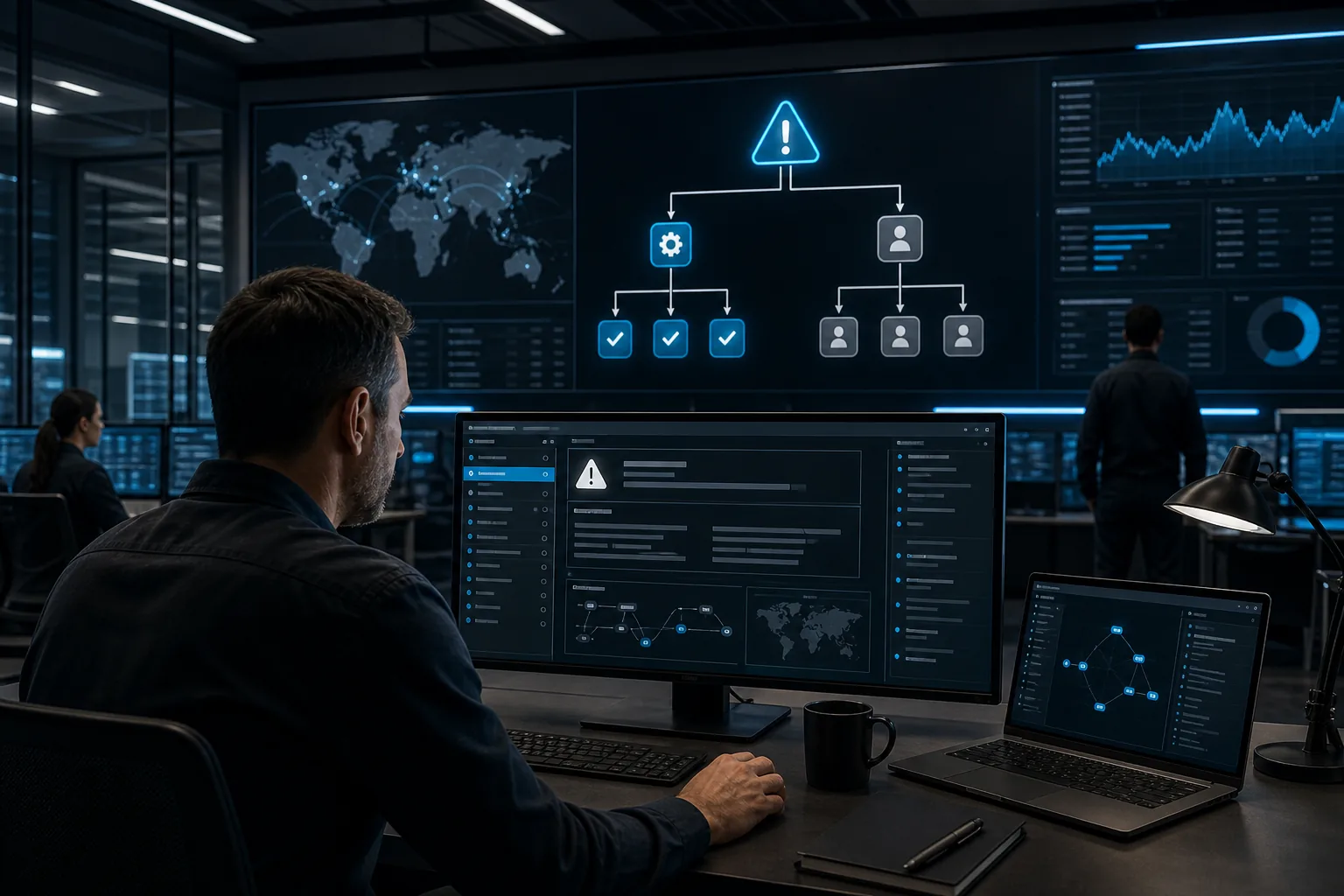
For regulated organizations, a qualified IT service provider can help review applicable cybersecurity guidance and document monitoring and post‑incident learning to support audit preparation.
Why Managed IT Guidance Matters for Implementation
Deploying AI incident response on your own can quickly become a rabbit hole of tooling, integration, and policy work. A managed IT partner brings three advantages.
First, we handle integration. Connecting AI sensors to your SIEM, ticketing system, and compliance dashboard takes dozens of API mappings. Our team does that mapping work for you, so your own staff can stay focused on running the business.
Second, we provide expertise. Our engineers know how to tune AI confidence thresholds, set appropriate approval workflows, and write playbooks that satisfy HIPAA and other regulations. That experience shortens the learning curve and helps you avoid costly missteps.
Third, we offer ongoing oversight. Threat landscapes evolve, and AI models drift. We continuously review alerts, update detection rules, and run tabletop exercises to keep your response plan fresh.
Partnering with a provider that already offers Managed Detection and Response Services means you get a single point of contact for both traditional and AI‑specific incidents. The result is faster mitigation, lower staffing costs, and a clear audit trail.
Frequently Asked Questions
What is the difference between AI incident response and regular incident response?
AI incident response adds steps that address model integrity, prompt‑injection attacks, and data‑poisoning, while regular incident response focuses on network, host, and application threats.
Do I need a separate AI security tool?
Not necessarily. Many SIEM and SOAR platforms now include AI‑driven modules that can be configured for AI‑specific alerts, but you still need a playbook that covers AI‑related scenarios.
How fast can AI reduce mean‑time‑to‑respond?
It depends on your tools and how many alerts you get. The biggest time savings usually come from automating triage and enrichment, the steps that eat most of an analyst’s time when alerts pile up.
Can AI automatically remediate an incident?
It can automate low‑risk actions such as revoking a token or isolating a single container, but high‑impact changes still require human approval.
What regulations does AI incident response help with?
It can help you meet HIPAA, PCI‑DSS, GDPR and industry rules by keeping the logs and audit trails auditors ask for and documenting each incident for breach‑notification decisions.
How do I start building an AI incident response plan?
Begin by inventorying every AI asset, then map each to a risk level, set up continuous monitoring, and create a playbook that defines detection thresholds, containment steps, and escalation paths.
Once you have the basics, a managed partner can fine‑tune the system and keep it aligned with evolving threats.
Conclusion
AI incident response gives you the speed of automation and the safety of human oversight. For regulated midsize firms, Advatek’s managed service provides the full package, 24/7 AI alerts, compliance‑ready reporting, and expert guidance.
Ready to protect your AI assets? Reach out for a quick assessment and see how quickly we can harden your response posture.
Download Franchise Information Report
Want to learn more about opening your own franchise? Fill out this form to get started: