
Best Network Penetration Testing Services
Finding a partner that can safely poke holes in your network is a must‑have step before a breach hits. Below is a short‑list of the ten firms that consistently deliver real‑world attack simulations, plus a quick guide on picking the right fit.
1. TrustedSec: Consultant‑led network, Active Directory, and red team depth
TrustedSec offers hands‑on network and AD assessments that mimic insider and external attacks. It’s best for orgs that need deep red‑team insight across on‑prem and hybrid clouds. The team emphasizes its industry certifications and client trust. Their engagements include social‑engineering drills and full‑cycle remediation advice. A caveat: the focus on consultant‑led work can stretch timelines for very large, multi‑site enterprises.

2. NetSPI: Managed testing programs for large regulated enterprises
NetSPI runs a continuous PTaaS platform that plugs into your ticketing system. It’s built for heavily regulated firms that need year‑round coverage of internal, external, cloud, and API surfaces. AI‑driven reconnaissance speeds up asset mapping, while 350+ in‑house pentesters handle the manual validation. Because the model leans on a platform, organizations that prefer a pure‑consultant engagement may find the onboarding effort higher.
Pro Tip: Ready to secure your network?
3. Praetorian: Engineer‑led testing for cloud‑native environments
Praetorian’s engineers focus on cloud‑first stacks, from AWS to Kubernetes. They validate misconfigurations, IAM flaws, and container breakouts that automated scanners miss. The firm holds CREST accreditation and serves SaaS teams that need rapid, code‑level feedback. Their reports map findings to frameworks like PCI DSS and HIPAA. The downside: smaller budgets may find the per‑engagement cost higher than a platform‑based option.
4. DeepStrike: Manual testing for SaaS, API‑heavy, and cloud‑first teams
DeepStrike delivers pure‑manual PTaaS with a 48‑hour start window and unlimited retests for 12 months. It shines for SaaS products that expose complex APIs and need business‑logic validation. Certifications include OSCP, OSWE, and CISSP, and reports are audit‑ready for SOC 2, PCI DSS, ISO 27001, and HIPAA. The trade‑off is a longer delivery cadence compared to AI‑assisted platforms.
5. Stingrai: Named CREST‑accredited testers across the attack surface
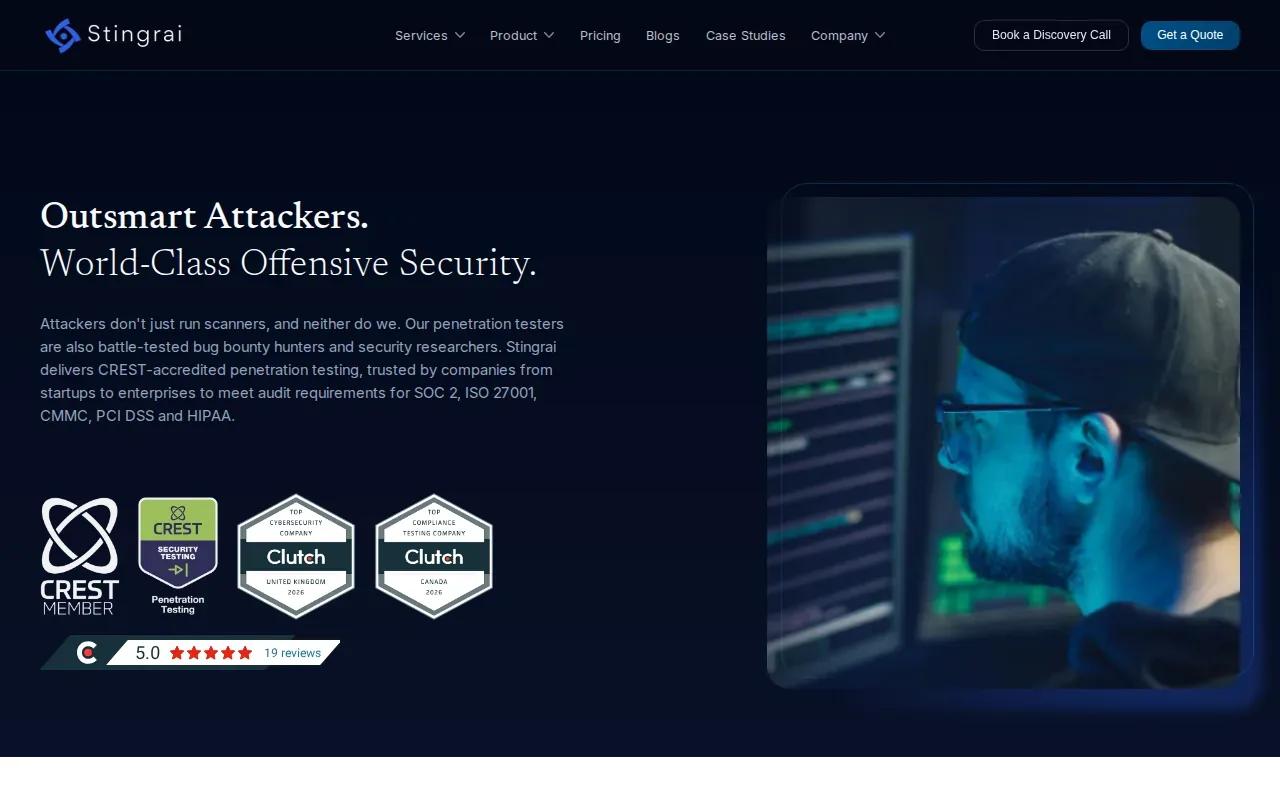
Stingrai assigns named, CREST‑accredited pentesters to every engagement, providing an attestation letter that auditors love. It covers internal, external, wireless, and segmentation testing in one contract. Pricing is published in U.S. dollars, making budgeting transparent. The service includes a retest policy and a 24‑hour quote turnaround. One limitation is that the firm operates remotely from Canada, which may raise data‑residency concerns for some U.S.‑only contracts.
Key Takeaway: Stingrai’s named‑tester model is ideal when you need auditor‑ready proof of who performed the test.
6. Rapid7: Broad testing for mid‑sized and large organizations
Rapid7 offers broad penetration testing for mid‑sized and large organizations. Certifications include CREST, OSCP, and CISSP, and its compliance coverage includes SOC 2, PCI DSS, and ISO 27001.
7. Bishop Fox: AI‑supported offensive security for large organizations
Bishop Fox blends a human‑on‑the‑loop model with its Cosmos AI engine. The AI scouts attack paths, then expert testers validate and expand them. This hybrid approach gives broad coverage quickly while keeping the depth of manual verification. Large enterprises with complex attack surfaces benefit from the scalability. However, the AI layer adds an extra cost component that smaller firms might find unnecessary.
8. Cobalt: PTaaS for mid‑market SaaS teams seeking a quick start
Cobalt’s community of 500+ vetted pentesters delivers a credit‑based testing model that can launch within days. It works well for SaaS companies that need fast, repeatable scans of web apps and APIs. The platform provides real‑time dashboards and integrates with ticketing tools. The trade‑off is less control over tester selection compared to boutique firms.
9. Black Hills Information Security: Open tooling and a training‑focused culture
BHIS emphasizes transparency, using open‑source tools and detailed walkthroughs. Their consultants teach clients how to read and act on findings, which raises internal security expertise. They’re a good fit for teams that value education alongside testing. Because they focus on manual validation, engagements can be longer and may lack the automation speed of larger platforms.
10. BreachLock: Subscription options for compliance‑led small and midsized businesses
BreachLock offers tiered subscription plans that scale with asset count. It targets SMBs that need PCI DSS, HIPAA, or SOC 2 evidence without a huge upfront budget. Tests are human‑augmented, not fully automated, and reports align with WASC Threat Classification and OWASP Top 10. The downside is that custom enterprise‑level engagements are limited, so fast‑growing firms may outgrow the service.
How to Choose the Right Provider
- Define the scope you need: internal, external, cloud, API, or segmentation.
- Check compliance coverage, make sure the provider maps findings to PCI DSS, HIPAA, NIST, etc.
- Evaluate delivery model, continuous PTaaS vs. one‑off manual engagements.
- Ask about reporting depth, executive summary plus technical remediation steps.
- Consider integration with your existing ticketing or SIEM tools.
Compare the 10 network penetration testing services by best-fit use case
| Provider | Best For | Typical Scope | Compliance Mapping | Delivery Model |
|---|---|---|---|---|
| TrustedSec | Deep red‑team & AD work | Network, AD, red team | PCI DSS, HIPAA, SOC 2 | Consultant‑led |
| NetSPI | Large regulated enterprises | Internal, external, cloud, API | PCI DSS, NIST SP 800‑53 | Managed PTaaS |
| Praetorian | Cloud‑native engineering teams | Cloud, containers, CI/CD pipelines | PCI DSS, HIPAA, SOC 2 | Engineer‑led |
| DeepStrike | SaaS, API‑heavy, cloud‑first | Web, API, cloud apps | SOC 2, PCI DSS, ISO 27001, HIPAA | Manual PTaaS |
| Stingrai | Named CREST testers across surface | Internal, external, wireless, segmentation | PCI DSS, HIPAA, ISO 27001, FedRAMP | Hybrid/Autonomous |
| Rapid7 | Mid‑size to large orgs on Rapid7 platform | Network, apps, cloud | SOC 2, PCI DSS, ISO 27001 | Platform‑integrated |
| Bishop Fox | AI‑supported large orgs | Network, cloud, apps, hardware | FedRAMP, PCI DSS | AI‑human hybrid |
| Cobalt | Mid‑market SaaS needing quick start | Web apps, APIs | PCI DSS, SOC 2 | Credit‑based PTaaS |
| Black Hills InfoSec | Teams that value open tooling & training | Network, manual validation | Varies per engagement | Consultant‑led |
| BreachLock | Compliance‑led SMBs | Web, mobile, internal/external | PCI DSS, HIPAA, SOC 2 | Subscription PTaaS |
Pro Tip: Pair any provider’s test with Advatek’s 24/7 network monitoring to turn findings into immediate remediation actions.
Frequently Asked Questions
What is network penetration testing?
Network penetration testing simulates real attacks on your internal and external infrastructure to expose exploitable weaknesses. The goal is to see how an attacker could move laterally, improve privileges, and access sensitive data.
How often should I run a network pen test?
Do I need both internal and external testing?
Yes. Internal testing shows what an insider or breached credential can do, while external testing reveals what an outsider sees from the internet.
Can AI replace human testers?
AI can speed up reconnaissance and identify low‑hanging fruit, but human expertise is still needed to validate complex attack chains and business‑logic flaws.
How do I know if a provider’s report is actionable?
Look for clear remediation steps, risk scoring tied to your environment, and integration options with ticketing or SIEM tools.
Conclusion
For most regulated midsize firms, NetSPI offers the most complete managed program, while Advatek can fill the gap with continuous monitoring and AI‑driven threat detection. Start a free security assessment with Advatek to see how our managed services complement any pen‑test you choose.
Download Franchise Information Report
Want to learn more about opening your own franchise? Fill out this form to get started: